
Why Your Tattoo Idea Might Be a Bad Idea
Not every bad tattoo starts with a bad drawing.
Sometimes the design is fine and the problem is the size. Sometimes the timing is terrible. Sometimes the placement turns a private idea into a public statement. Sometimes the client picked the wrong artist. Sometimes the skin simply is not ready to be tattooed.
And sometimes the tattoo idea itself is not really the problem at all. The problem is the client refusing to let the idea change enough to actually work on skin.
That is the part people do not always understand.
A tattoo artist saying, “I don’t think you should do this,” is not automatically gatekeeping. Sometimes it is the artist looking at the size, placement, design, skin, timing, or long-term consequences and realizing that what sounds good in your head may not translate the way you think it will.
That does not mean the artist owns your body. It means there are situations where “Can I tattoo this?” and “Should I tattoo this?” are two very different questions.
1. The Tattoo Is Too Small for What You Want It to Do
This is one of the most common bad tattoo ideas I see.
People want too much information packed into too little space.
Long lettering. Tiny architecture. Portraits with tons of detail. Complicated symbols with microscopic internal lines. A full illustration compressed into two inches because the client wants it “small and cute.”
At a certain point, smaller is not just smaller. Smaller means something has to go.
Lines need separation. Lettering needs room. Shading needs space. Tiny details can soften and lose clarity as a tattoo ages. The issue is not whether I can physically fit the design into a small area. The issue is whether it will still read the way you want it to later.
This is why I often print multiple sizes and show clients exactly what they are choosing between.
If the smallest version means deleting half the details, simplifying the composition, or changing the entire character of the design, then the client needs to understand that tradeoff before we start.
I wrote a whole article about this because it comes up constantly: Should You Get a Small Tattoo or Go Bigger?
The short version is simple: you can choose the smaller size, but you may not be able to choose the exact same design.
2. The Timing Is Bad Even If the Tattoo Is Fine
Sometimes the idea is not bad.
The timing is.
Getting your new partner’s name after three weeks together? Maybe wait.
Getting tattooed drunk on vacation because everybody is having the best night of their lives? Probably not the moment to make a permanent decision.
Losing a bet, getting pressured by friends, rushing out after a breakup, or deciding you need a giant memorial tattoo within hours of losing somebody can all come from the same place: emotion is driving the decision faster than thought can catch up.
I understand why people do it.
If you are grieving, you may want something permanent because the loss feels unbearable. If you are in love, you may want to prove how permanent that feeling is. If you are partying somewhere new, the tattoo can feel like the perfect way to preserve the night.
But intense emotions make permanent decisions feel urgent when they may not actually be urgent.
I am not against memorial tattoos. I am not against relationship tattoos. I am not against spontaneous tattoos.
I am against pretending that timing has nothing to do with whether a tattoo becomes something you love or something you regret.
If the tattoo still feels right once the emotional temperature drops, great. You can always get it then.
3. The Placement Turns the Tattoo Into a Bigger Statement Than You Intended
Placement matters for more than aesthetics.
A tattoo on your thigh and the same tattoo on your face do not live the same social life.
Face, neck, hand, and finger tattoos are sometimes called “job stoppers” for a reason. That does not mean everybody with a visible tattoo is unemployable, and plenty of industries are much more accepting than they used to be.
But highly visible tattoos can still affect how people interpret you, especially in workplaces or environments where appearance and professionalism are judged more conservatively.
You may know exactly why you have a marijuana leaf, political symbol, obscene cartoon, or Bitcoin logo tattooed on your face.
The person interviewing you does not know you yet.
They are seeing the tattoo before they know the story.
Whether that judgment is fair is almost beside the point. Once you put something in a place that cannot easily be covered, other people get to interpret it for themselves.
That is why I especially hesitate when someone wants a highly visible tattoo as their first tattoo or wants something polarizing placed on the face, neck, or hands.
You may still decide it is worth it.
But you should understand what you are choosing.
4. A Symbol Can Mean Something Very Different to Everyone Else
This is one of the hardest parts of tattooing because symbols do not exist in a vacuum.
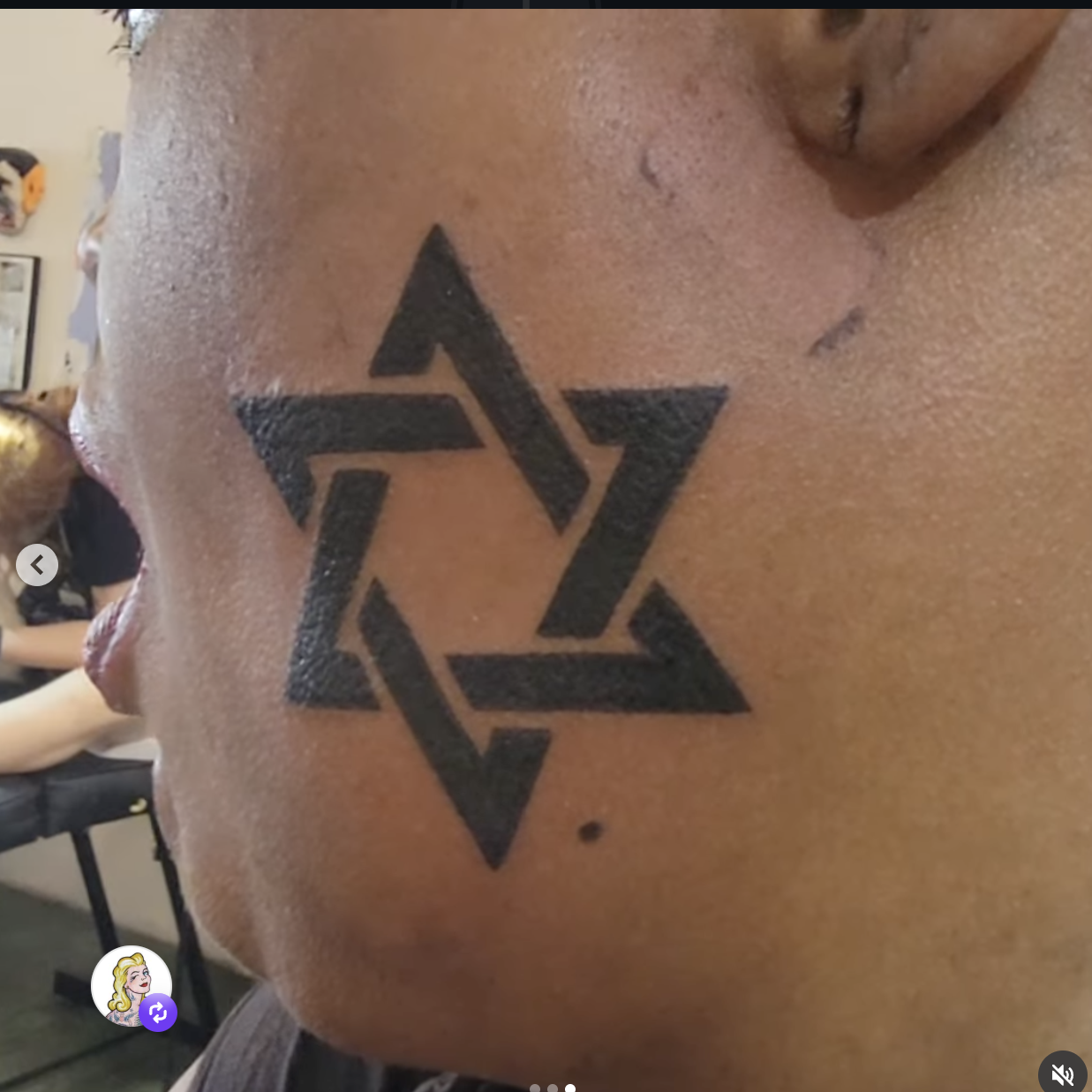
I recently tattooed a large Star of David on a woman’s face.
It was her body. Her choice.
I talked to her about it before we did it, and I still wrestled with the decision afterward.
When I posted the tattoo online, the response was split. Some people saw a religious or cultural symbol. Others interpreted the image through politics, conflict, identity, or ideology.
That is what makes these tattoos complicated.
The client may have one meaning in mind, while the rest of the world attaches ten others.
A swastika is an even more obvious example of a symbol carrying enormous historical weight. “666” can mean something playful to one person and something deeply offensive or threatening to another. Religious symbols, political symbols, gang-related imagery, extremist imagery, or even certain numbers and hand signs can carry meanings a client may not fully understand.
I do not think every tattoo artist has to become the moral police.
But I do think there is some responsibility to slow the conversation down when the imagery is highly loaded.
The question becomes: does the client understand what this symbol may communicate to people who do not know their private intention?
Because once a symbol is large, visible, or placed on the face, it stops being entirely private.
5. You Only Want It Because Everybody Else Wants It Right Now
Trends are not automatically bad.
Every generation has tattoo styles that immediately reveal when the tattoo was probably done.
That is part of tattoo history.
But trends can become a problem when the client has no real attachment to the idea beyond the fact that it is popular right now.
Celebrity tattoos are a perfect example.
People get tattoos of musicians, actors, athletes, influencers, brands, and fandom symbols when their relationship with that person or franchise feels permanent.
Then the celebrity becomes controversial.
The fandom changes.
The person changes.
The client changes.
Suddenly the tattoo is attached to something they no longer identify with.
That does not mean you should never get a Kanye tattoo, Drake tattoo, Harry Potter tattoo, Pokémon tattoo, anime tattoo, or anything else tied to a cultural moment.
It means you should ask yourself whether you like the tattoo itself enough to keep wearing it if your relationship with the subject changes.
The same thing applies to visual trends.
Cybersigilism, ultra-fine-line work, watercolor tattoos, infinity symbols, tribal designs, micro tattoos — every style has a moment.
A trend dating itself is not automatically a failure.
The problem is when you only liked the tattoo because the trend told you to like it.
6. You Chose the Wrong Artist for the Tattoo
Sometimes the bad idea is not the tattoo.
It is asking the wrong artist to do it.
This happens constantly.
Someone sees that an artist tattoos well and assumes that means they tattoo everything well.
They do not.
A great traditional tattoo artist may not be the person you want doing micro-realism. A fine-line artist may not be the best fit for a giant full-color portrait. Someone who does beautiful lettering may not be comfortable with realistic animals.
Portraits are a particularly unforgiving example.
If you ask an artist who does not really do portraits to tattoo your grandmother’s face, you are asking for a very specific skill set that they may not have developed yet.
Artists learn their strengths and weaknesses through experience too.
I have done things in my career that taught me very quickly, “Okay, this is not where I am strongest.”
That is part of learning.
The dangerous situation is when neither the client nor the artist realizes that mismatch before the tattoo starts.
Clients should vet the artist, not just the price.
Look for the style you actually want in their portfolio. Look at healed work when you can. See whether they consistently produce the kind of tattoo you are asking them to produce.
I go deeper into that here: How to Choose a Tattoo Artist You Can Trust.
7. Your Cover-Up Plan Is Fighting Reality
This is one reason I personally do not take a ton of cover-ups.
People come in asking for things that sound impossible because they do not understand what a cover-up actually has to accomplish.
They want a large tattoo covered by something smaller.
They want something very dark covered by something extremely light and delicate.
They have fresh scar tissue and expect the new tattoo to make the texture disappear.
Or they simply say, “I want this covered,” without having any idea what they want to replace it with.
A cover-up is not just putting a new picture on top of an old one.
You are designing around what is already in the skin.
That means size, darkness, saturation, scar tissue, placement, and the client’s willingness to go larger all become part of the solution.
There are tattoo artists who specialize in cover-ups and can pull off things that genuinely surprise me.
That is exactly why I think cover-ups should go to somebody who really understands them.
Sometimes the bad idea is expecting a tattoo artist who does not specialize in that work to perform magic.
8. Your Skin Is Telling You “Not Today”
There are situations where I do not care how good the idea is.
I am not tattooing the skin that day.
Fresh scars, active eczema, psoriasis flare-ups, sunburn, irritated skin, infection, open wounds, or anything that looks medically questionable needs to be healed, treated, and stable before I am going near it.
If I am unsure, I will ask for medical clearance.
There is no clever design solution that makes unhealthy skin ready to tattoo.
This is especially important with scar tissue. A healed, mature scar and a fresh or actively changing scar are completely different situations.
I already broke that down in detail here: Can You Tattoo Over Scars? What You Should Know.
Sometimes the tattoo is not a bad idea.
Today is just a bad day to do it.
9. Your Reference Image Is Not a Tattoo Blueprint
This has become even more important because clients are now making AI-generated images and bringing those images into tattoo shops.
AI can make something look incredible on a screen.
That does not mean every part of the image makes sense as a tattoo.
The design may contain impossible anatomy, strange lighting, microscopic textures, inconsistent patterns, too many focal points, or details that only work because the image is digital and backlit.
The same problem happens with Pinterest, Instagram, or screenshots of another person’s finished tattoo.
Clients sometimes become so attached to the reference that they do not want the artist to change anything.
That can become a problem.
A seasoned tattooer has to understand what the client actually loves about the reference and then take control of the mission.
Maybe the client loves the silhouette.
Maybe it is the flower placement.
Maybe it is the expression, the contrast, the color palette, or the mood.
The artist’s job is to preserve those important parts while rebuilding the image into something that works on skin.
That is where persuasion becomes part of tattooing.
If I can take your reference, redesign it within the boundaries of what you wanted, and then show you a version so strong that you say, “Actually, yeah, yours is better,” that is the goal.
Sometimes the difference between a bad tattoo and a great one is whether the client lets the artist move beyond the screenshot.
If you want more detail on why artists sometimes alter designs before the appointment, read Why Tattoo Artists Might Change Designs Before the Session.
A Good Tattoo Artist May Push Back
Pushback is not automatically rejection.
Sometimes “no” actually means:
“Not that small.”
“Not on that part of the body.”
“Not while the skin is irritated.”
“Not exactly like that reference.”
“Not today.”
“Not with me, because someone else is better suited for this style.”
That distinction matters.
The best tattoo conversations are collaborative.
You should still recognize your own idea when the design is finished. But part of hiring an experienced artist is letting them use the experience you are paying for.
I wrote more about that here: Why Tattoo Artists Say No to Some Ideas.
How to Pressure-Test a Tattoo Idea Before You Commit
You do not need to overthink every tattoo for six months.
You also do not need to turn every tattoo into a spiritual journey.
Sometimes you just want a cool tattoo.
That is enough.
But before committing, ask yourself a few questions.
Would I still want this if it were not trending?
Am I okay with strangers interpreting this symbol differently than I do?
Is this placement going to create consequences I have not really considered?
Am I choosing this artist because they actually do this style well, or because they are cheap, nearby, or available?
Am I willing to make the design larger or simpler if that is what it needs?
Is my skin healthy enough to tattoo right now?
And am I attached to the idea, or am I attached to one exact screenshot?
You do not have to answer every question perfectly.
You just need to understand what you are choosing.
Sometimes the Idea Is Fine. It Just Needs a Better Version.
Most bad tattoo ideas are not completely hopeless.
The tattoo may need to be bigger.
The placement may need to change.
The symbol may need more thought.
The timing may need to cool down.
The skin may need to heal.
The reference may need to be redesigned.
Or you may simply need a different artist.
That is why I do not think the phrase “bad tattoo idea” should automatically mean “stupid tattoo.”
Sometimes the idea is good.
The current plan is bad.
And fixing the plan before the needle touches skin is a whole lot easier than fixing the tattoo afterward.