
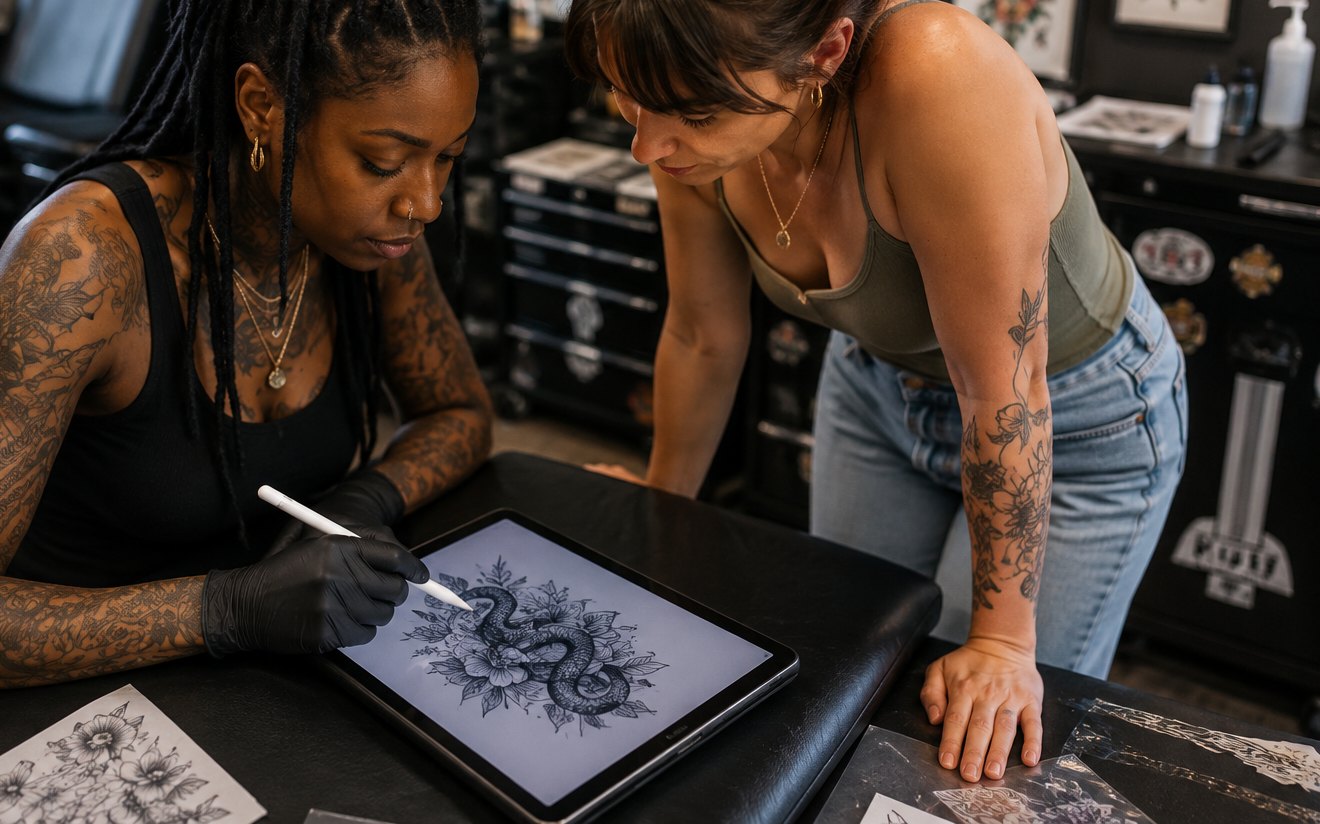
Why Your Tattoo Artist Might Say No to Your Idea
When a client shows me a tattoo idea and my first reaction is, “No, I’m not tattooing it like that,” I am usually not rejecting the entire idea.
I am already trying to figure out how to make it work.
What can I add? What can I subtract? Does it need to be bigger? Does it belong somewhere else on the body? Is there too much detail for the amount of skin we have available?
A good tattoo artist saying no does not always mean, “I refuse to tattoo you.” A lot of the time it means, “I don’t think this version of your idea is going to give you the tattoo you really want.”
And when I push back, I am often thinking about somebody the client is not thinking about yet: the future version of them who will still be wearing this tattoo years from now.
Sometimes the Tattoo Is Simply Too Small for the Idea
One of the fastest ways to get me to start modifying a design is to bring me something incredibly detailed and then ask me to make it tiny.
If somebody wants Jesus and the Last Supper on the back of their hand, we have a problem.
It may be possible to make something incredibly intricate look beautiful when the tattoo is fresh. The issue is what happens after the fresh-photo stage.
Tattoos live in skin. They are not printed onto paper. Over time, tattoo lines can soften and lose some of their original sharpness. When a design contains a large amount of information packed into a very small area, there is less space between those details as they age.
That means tiny windows, facial features, lettering, architectural details, or very closely spaced lines may eventually lose some of the separation that made the fresh tattoo so impressive.
I have shown clients examples of extremely detailed hand tattoos that looked gorgeous when they were fresh and, years later, had lost much of the definition that made the original design special.
That is why I may recommend making the tattoo larger or simplifying the design.
I am not trying to make you spend more money or take up more skin just because I feel like it. I am trying to give all of those details enough room to continue being recognizable later.
If you are unsure how size affects the way a tattoo ages, my tattoo size guide goes deeper into why some designs simply need more space.
Placement Can Change Whether a Design Works
There are very few places on the body where I would say tattoos simply do not belong.
There are painful placements. There are awkward placements. There are places that are technically harder to tattoo.
But the bigger question is whether the specific design works in the place the client chose.
Portraits on the Neck
Portraits on necks are one placement I tend to approach cautiously.
I understand why people like them. A well-done neck portrait can look striking when the person is standing straight and the skin is relaxed.
But a neck moves and stretches constantly.
If we are tattooing a recognizable face—your child, your grandmother, somebody you love—the relationship between the features matters. When the head turns and the skin stretches, that face can distort along with it.
That does not mean nobody should ever get a portrait on their neck. It means I am going to make sure the client understands what that placement does before we commit to it.
Hands and Palms
Hands create a different kind of challenge.
The backs of the hands are generally more forgiving than palms, but palms can be difficult areas for consistent tattoo retention.
In my experience, they are simply not as predictable as many other placements. They deal with constant movement, friction, washing, sweat, and everyday use.
That does not mean a palm tattoo cannot work. It means I want the client to understand that the expectations may be different from getting the exact same design somewhere like the upper arm or thigh.
Sometimes We Have to Move the Stencil Until We Find It
A client might tell me, “I want this on my arm,” but that still leaves us with a lot of real estate.
Above the elbow?
Below it?
Forearm?
Upper forearm?
Front of the arm?
Shoulder?
Near the wrist?
Sometimes we just have to try the stencil in a few different places.
I have gotten more comfortable over the years taking a little authority in those moments because I have developed an eye for what generally looks balanced on a body. I still let the client lead me, but if something looks off, I am going to say something.
Then we move it.
Maybe we move it again.
And maybe again.
Moving a stencil two, three, or four times does not automatically mean somebody is being difficult. Sometimes you just have to find it.
Once the design lands in a place where the client and I both look at it and think, “Yeah, that belongs there,” we are ready.
When You Bring Me Someone Else’s Tattoo
Clients bring reference photos all the time. That is completely normal.
If somebody shows me a tattoo on another person and says, “I want this,” my first response is usually not to lecture them.
I ask them a question:
“What do you like about it?”
Maybe they love the flowers.
Maybe it is the animal in the center.
Maybe they like the amount of black.
Maybe they like the composition, the movement, the shading, or the general mood.
Once I understand which elements they are actually responding to, I can start building something from those ingredients instead of simply reproducing somebody else’s tattoo.
That gives me room for personalization and gives the client something that actually fits their body.
Reference photos are extremely useful. They help communicate visual ideas that can be difficult to describe with words. But the strongest custom tattoo usually comes from using references as a direction instead of treating another person’s finished tattoo like a photocopy.
Sometimes “No” Really Means “Let Me Redesign This”
There is a major difference between refusing a tattoo and refusing the exact way the client initially presented it.
Most of the time, I am trying to preserve the thing they actually care about.
If the design is too crowded, maybe we remove something.
If it is too small, maybe we make it larger.
If the placement fights with the composition, maybe we move it.
If a reference does not quite fit their body, maybe I redraw it so it does.
This is also why an artist may make changes to a design before the appointment. I explain that process more in why tattoo artists might change designs before the session.
And if you arrive at your appointment and realize something about the design needs to change, that does not automatically mean the appointment is ruined. I also have a guide on changing a tattoo design on appointment day.
There Are Also Things I Will Not Tattoo
There are situations where redesigning is not the answer.
I once had someone ask about an anti-swastika design where the symbol would be crossed out, similar to a “no smoking” sign.
I understood what the design was trying to communicate.
But I also realized that in order to create it, I would still physically have to tattoo a swastika.
My answer was no.
Every tattoo artist is allowed to have boundaries around the imagery they are willing to put into somebody’s skin. Those boundaries are not always identical from artist to artist.
There are also times when I will postpone or refuse a tattoo because of the condition of the skin rather than the artwork itself. Open wounds, active inflammation, significant irritation, or questionable scar tissue need to be handled differently from healthy skin.
We covered that much more thoroughly in the previous article about tattooing over scars and altered skin.
What If You Want the Tattoo “Upside Down”?
This is probably the most common situation where a client chooses something different from what I recommend and I simply say: okay.
For example, somebody getting a tattoo on their forearm may want the design facing them so it appears upright when they look down at it.
A common tattooing convention is to orient the design so that it appears upright to somebody looking at the wearer while their arm is resting naturally.
I explain that.
Then I let the client decide.
If they understand the convention and still want the tattoo facing themselves, I will usually tattoo it that way.
It is their body.
My job is to make sure they understand the choice they are making—not to turn their arm into my personal billboard.
Your Tattoo Artist Is Advising You, Not Owning Your Body
This balance matters.
I have professional opinions because I have spent years designing, placing, tattooing, and watching tattoos heal and age.
But I also do not want to fight my clients.
If I think something would look better another way, I will tell them.
I will show them another placement.
I will offer another size.
I will simplify a design.
I will explain what concerns me.
But ultimately I want the person leaving my chair to feel proud of what is on their body.
Most of my consultations are not contentious. Usually, listening carefully to what somebody is trying to accomplish gives us enough information to find a version that works for both of us.
If you want to understand what that conversation looks like before you book, read what happens at a tattoo consultation.
When I Say No, I Am Thinking About Future You
I wish more clients understood that when I push back on an idea, I am genuinely not trying to be a dick.
Yes, there are tattoo artists who can be difficult simply because they enjoy being difficult.
But when I am telling somebody that their design needs to change, there is usually a reason.
I am erring on the side of caution.
I am using the experience I have developed from designing, placing, tattooing, and watching tattoos change over time.
Most importantly, I am erring on the side of what the future version of you might have wanted.
Today you might be completely in love with the idea of squeezing twenty tiny details into two inches of skin.
Future you is the one who has to wear what those details become.
Today you may only be thinking about how the stencil looks when you hold your arm perfectly still.
Future you will be moving that arm every day.
A tattoo artist’s job is not simply to obey every instruction without thinking about the result. It is also not to hijack somebody’s idea and make the tattoo about themselves.
The sweet spot is somewhere between those two things.
You bring me the idea.
I bring what I know about tattooing.
Then we figure out how to make those two things meet.
So Why Would a Tattoo Artist Say No?
A tattoo artist may push back because the design is too detailed for the requested size, because the placement is working against the design, because the skin is not appropriate to tattoo, because the reference needs to be reworked, or because the artist simply has a professional or personal boundary around the request.
A good “no” should usually come with an explanation.
And very often, it should come with another possibility.
No, not that small—but we can make it work larger.
No, not exactly like that reference—but tell me what you love about it and let me build something for you.
No, I do not love that placement—but let me show you three places where this design might sit better.
Sometimes a tattoo artist saying no is not the end of your idea.
It is where the better version starts.
If you are still deciding who you trust to have those conversations with, read how to choose a tattoo artist you can trust.