
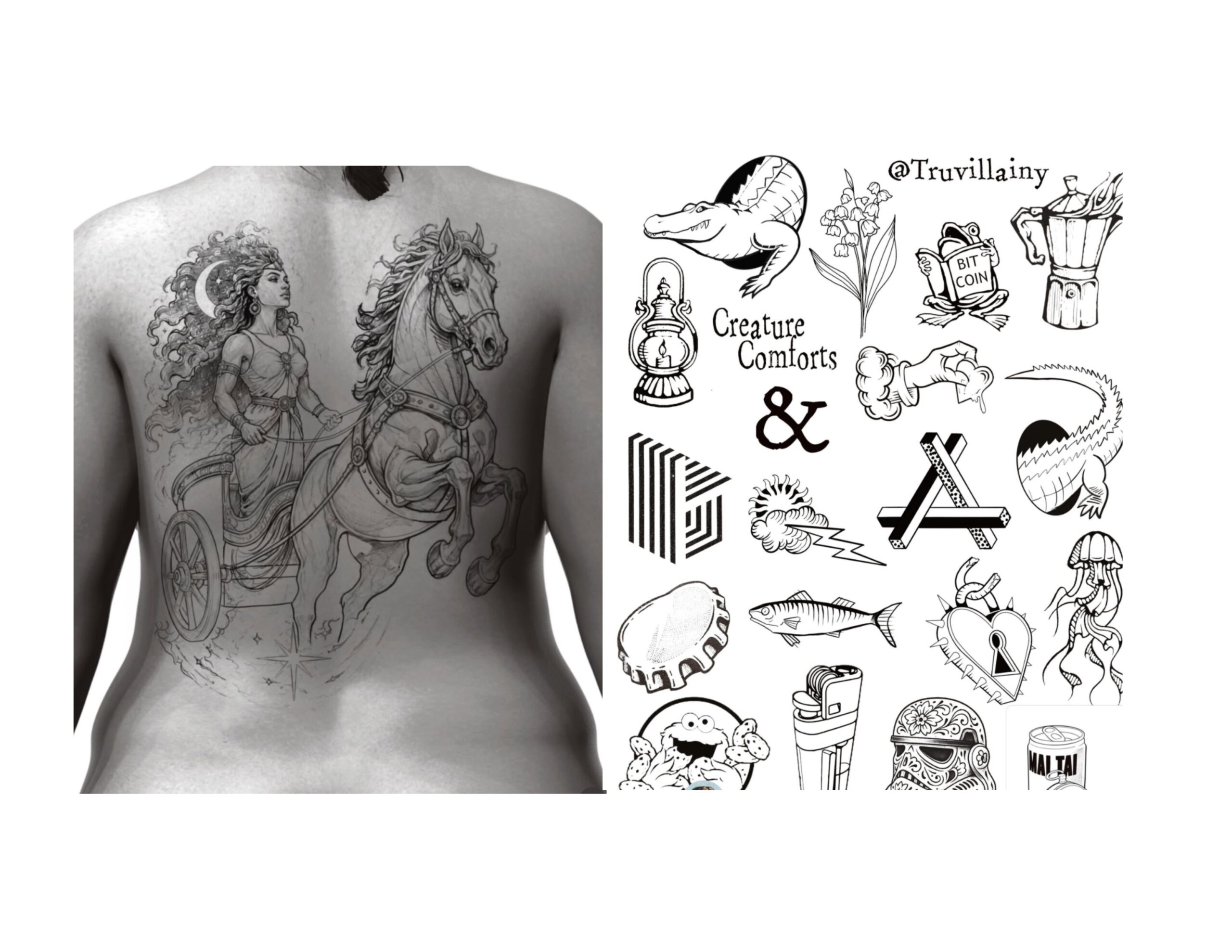
Flash Tattoo vs Custom Tattoo: Which Is Right for You?
Some people walk into a tattoo shop knowing exactly what they want. They have screenshots saved, references organized, a specific placement in mind, and maybe an idea they have been carrying around for years.
Other people walk in knowing only one thing: I want a tattoo today.
Neither person is doing tattooing wrong. They just may need two very different approaches.
That is where the difference between a flash tattoo and a custom tattoo becomes useful. Flash gives you something that already exists. Custom gives you something that has to be created or changed specifically for you.
One is not automatically better than the other. The better choice depends on how specific your idea is, how much time you have, how much you want to spend, and how involved you want to be in the design process.
What Is a Flash Tattoo?
Flash is simply tattoo artwork that has already been drawn before you choose it.
It might be hanging on the wall, painted on a flash sheet, sitting inside a book at the shop, posted as an available design online, or even folded up inside one of those little plastic capsules in a get-what-you-get machine.
The format does not really matter. The important part is that the artwork already exists.
The artist has already decided how the design looks, where the lines go, how thick those lines should be, what colors belong in it if it is a color piece, and roughly what size will allow the tattoo to work.
That is part of what makes flash appealing. You are not beginning with a blank sheet of paper.
What Makes a Tattoo Custom?
A custom tattoo is anything I have to create or significantly change for the client.
Sometimes that means drawing an entire tattoo from scratch. Other times, it can start with an image that already exists.
Say you want a Rick and Morty tattoo. The original image has Morty holding one object, but you want him holding a stack of money, a cellphone, or a Styrofoam cup instead.
Now I have to change the drawing.
That is custom work.
The same thing applies if you choose a flower and want the stem redesigned into your mother’s initial, or you want several separate references combined into one tattoo.
There is no official percentage where a design suddenly becomes custom. If I have to redesign it to fit your request, then we have moved into custom territory.
You could theoretically take a Bart Simpson design, completely disassemble him, rearrange the pieces into some ridiculous Mr. Potato Head-looking creation, and that would still be a custom tattoo. The question is not how strange the change is. The question is whether the artwork has to be redesigned for you.
The Biggest Advantage of Flash: It Kills Indecision
One of the biggest advantages of flash is how quickly it solves the problem of not knowing what you want.
If you walk into the shop saying, “I want a tattoo, but I have no idea what I want,” I can hand you a stack of flash books and say:
Here are 30 books. Find something that speaks to you.
That is much easier than trying to pull a tattoo concept out of thin air.
Flash is especially useful for someone who:
- wants to get tattooed that day,
- is feeling spontaneous or impulsive,
- likes the artist’s existing work but does not have a specific concept,
- is visiting from out of town,
- is working with a tighter budget, or
- just does not want to spend hours developing an original design.
The design is already sitting there. You can see exactly what it looks like. I already understand how I want to tattoo it. That can make the entire process much faster.
Flash is also often easier to accommodate as a same-day tattoo because there is less preparation involved. There is no long drawing process before we can even get to the stencil.
Flash Is Usually More Budget-Friendly
For me, flash is typically cheaper than custom work.
That does not mean every flash tattoo is cheap. A large or detailed piece can still take significant time to tattoo.
But with flash, a lot of the work has already happened.
I have already chosen the size. I have already made decisions about the lines. I know the line weight. If there is color, I generally already know the palette. I know how the composition works.
With custom work, I am still figuring all of that out.
A custom drawing may go through two or three versions before I reach something I actually like enough to tattoo. Sometimes that design process takes hours.
We live in a time when people can type an idea into an AI tool and generate an image in seconds, but generating an image and developing a tattoo design are not necessarily the same thing. I still have to look at the idea, decide what works on skin, make changes, simplify things, fix things, redraw things, and sometimes start over.
That extra design time is part of what the client is paying for with custom work.
The Biggest Advantage of Custom: It Carries Your Personal Lore
The appeal of custom work is personalization.
A flower can just be a flower.
But maybe you want that flower because your mother grew them in her backyard, and you want the stem shaped subtly into her initial.
Now the tattoo is not simply a flower anymore.
It carries a piece of your own story.
That is what people often love about custom tattoos. They can take something recognizable and build your own history, humor, memories, relationships, or personality into it.
You might want a cartoon character holding something that relates specifically to your life. You might want an animal mixed with a particular flower. You might want several references combined into one composition.
Flash cannot always give you that level of specificity because the design was created before you entered the picture.
Custom allows the tattoo to be built around you.
Flash Does Not Mean Your Tattoo Has No Meaning
At the same time, I do not believe every tattoo needs some deep backstory.
Meaning is something the person wearing the tattoo gets to decide.
You could choose a blue butterfly from a flash sheet because it reminds you of your grandmother. Maybe you used to see blue butterflies together when you were a kid. The second you make that connection, that tattoo has meaning to you.
Someone else could get the exact same blue butterfly because they are 19 years old, they think blue butterflies are cute, and they want one near their hip.
That is fine too.
One tattoo can carry an entire family story while the identical tattoo on someone else can mean nothing beyond:
I saw it. I liked it. I wanted it.
Both are completely valid reasons to get tattooed.
Sometimes tattoos even gain meaning after you get them. You live your life with them. You go through relationships, losses, moves, careers, vacations, mistakes, victories, and everything else while that tattoo is sitting there on your body.
Eventually, the tattoo becomes associated with a period of your life whether that meaning existed on day one or not.
I apply the tattoo. What it means is ultimately up to the client.
One Thing to Understand About Flash: Other People May Have It
Traditional flash is often designed to be tattooed more than once.
Some artists offer one-and-done flash, where a design is retired after one person claims it. But unless that has been clearly stated, you should assume another person could choose the same piece.
That little leprechaun, four-leaf clover, dagger, rose, skull, or pinup you picked off the wall may already exist on someone else.
For some people, that matters.
For others, it does not matter at all.
And realistically, what are the chances you walk into a random bar three years later and meet the other person who has the exact same tattoo?
If that happens, honestly, it is kind of funny.
Out of all the tattoo designs in the world, two unrelated people from completely different places somehow chose the same one. I have seen people bond over things like that.
If being the only person with your exact design is extremely important to you, custom is probably the better direction.
Flash Is Usually Drawn at a Certain Size for a Reason
One of the most common questions people ask about flash is:
“Can you make it smaller?”
Sometimes, yes.
But not always.
If I drew a piece at a certain size, there is usually a reason for that. The spacing, linework, and amount of detail were designed with that scale in mind.
If you shrink the entire thing too far, all of those details get compressed. Elements that looked clear at the original size can become harder to distinguish.
That does not mean the client can never change the scale. It means the design may have to change with it.
If size is one of your biggest concerns, I go into this much deeper in my guide on whether you should get a small tattoo or go bigger.
Custom Does Not Mean Unlimited Revisions
Custom tattoos create their own misunderstandings.
One of the biggest is the idea that “custom” means unlimited revisions, unlimited micromanaging, and somehow unlimited mind-reading from the artist.
It does not.
The artist needs enough direction to understand what you actually want.
A phrase I hear all the time is:
“Do your thing.”
That sounds like complete creative freedom, but sometimes it really is not.
For example, imagine you ask me for an Attack on Titan manga-style tattoo. You already chose a very recognizable visual style.
Then you tell me to “do my own thing.”
Okay. How far?
If I change the style too much, it may no longer look like the thing you asked for. But if I stay very close to the original manga style, maybe you feel like I did not add enough of my own personality.
That can get frustrating very quickly.
The same thing happens when someone tells an artist to “freak it out” or “put your own twist on it,” then sees the artist’s interpretation and realizes they actually wanted something much closer to the reference.
If you want something specific, say that.
If you want the artist to take creative freedom, that is fine too. But understand that creative freedom means you may see choices you did not personally imagine beforehand.
Custom works best when the client gives useful direction without trying to control every millimeter.
Your Reference Is a Starting Point, Not a Mind-Reading Device
A good custom client usually has some idea of what they want.
They may have been carrying screenshots around in their phone for months. They may have a folder of references. They may know the subject, placement, symbolism, and overall mood.
That information helps tremendously.
What becomes difficult is expecting the artist to somehow reproduce the exact image that exists only inside your head.
If your request is very specific, communicate what matters most:
- the subject,
- the placement,
- the approximate size,
- the style,
- any important symbols or details,
- what absolutely needs to stay, and
- what you are comfortable letting the artist reinterpret.
The clearer the brief, the easier it is to build something both you and the artist understand.
I also explain why artists sometimes need to alter references in Why Tattoo Artists Might Change Designs Before the Session.
Who Is Usually Better Suited for Flash?
If I had to describe the ideal flash client, it would be somebody who says:
“I like your work. I want something today. Show me what you’ve got.”
Flash tends to work well for people who are:
- more spontaneous,
- unsure what subject they want,
- working with a tighter budget,
- looking for a same-day tattoo,
- already fans of the artist’s style, and
- not particularly concerned about having a completely one-of-one design.
Maybe you have followed an artist on Instagram for two years and love almost everything they draw. You happen to be in town. You want something from them, but you do not have some grand concept.
That is a perfect situation for flash.
You are essentially saying, “I trust your taste. Let me see what is available.”
Who Is Usually Better Suited for Custom?
The custom client is usually a little different.
They tend to know what they want.
They may have been thinking about the tattoo for a long time. They are more particular about how the concept is portrayed. They may be more selective about which artist they choose, because the artist needs to understand both the subject and the style they are asking for.
Custom clients are often willing to spend more because getting the details right matters more to them than choosing the fastest or cheapest option.
They want to be specific about symbolism, composition, personality, or storytelling.
One way I think about it is this:
Flash works well when you trust the artist more than you trust your own idea. Custom works well when the idea itself is the thing you are trying to protect.
So Which Is Better: Flash or Custom?
Neither.
They solve different problems.
Choose flash when you want to get tattooed, love the artist’s existing work, and do not need the design to be uniquely created around your personal story.
Choose custom when you already have something specific in mind and the details are important enough that the artwork needs to be created or changed specifically for you.
You can also start with flash and end with custom. If you choose an existing design and then ask for significant changes, that is completely fine. It just means the artist now has design work to do before tattooing it.
That may change the price, preparation time, and possibly whether the tattoo can still happen the same day.
Do Not Overcomplicate the Decision
You do not need a personality test to determine whether you are a flash person or a custom person.
Ask yourself a few basic questions:
- Do I already know exactly what I want?
- Do I care if someone else has the same tattoo?
- Do I want something today?
- Is my budget tight?
- Do I want personal symbolism built into the artwork?
- Am I comfortable giving the artist creative freedom?
- Do I simply love one of the artist’s existing designs exactly as it is?
Your answers will usually make the choice pretty obvious.
A great tattoo does not become less great because it came out of a flash book.
And a tattoo does not automatically become better just because someone spent six hours designing it specifically for you.
Sometimes the perfect tattoo is the one hanging on the wall that you notice the second you walk into the room.
Sometimes it is the idea you have been carrying around in your phone for three years waiting for the right artist to bring it to life.
Both are tattooing.
Both can be personal.
And both can be exactly the right choice.