
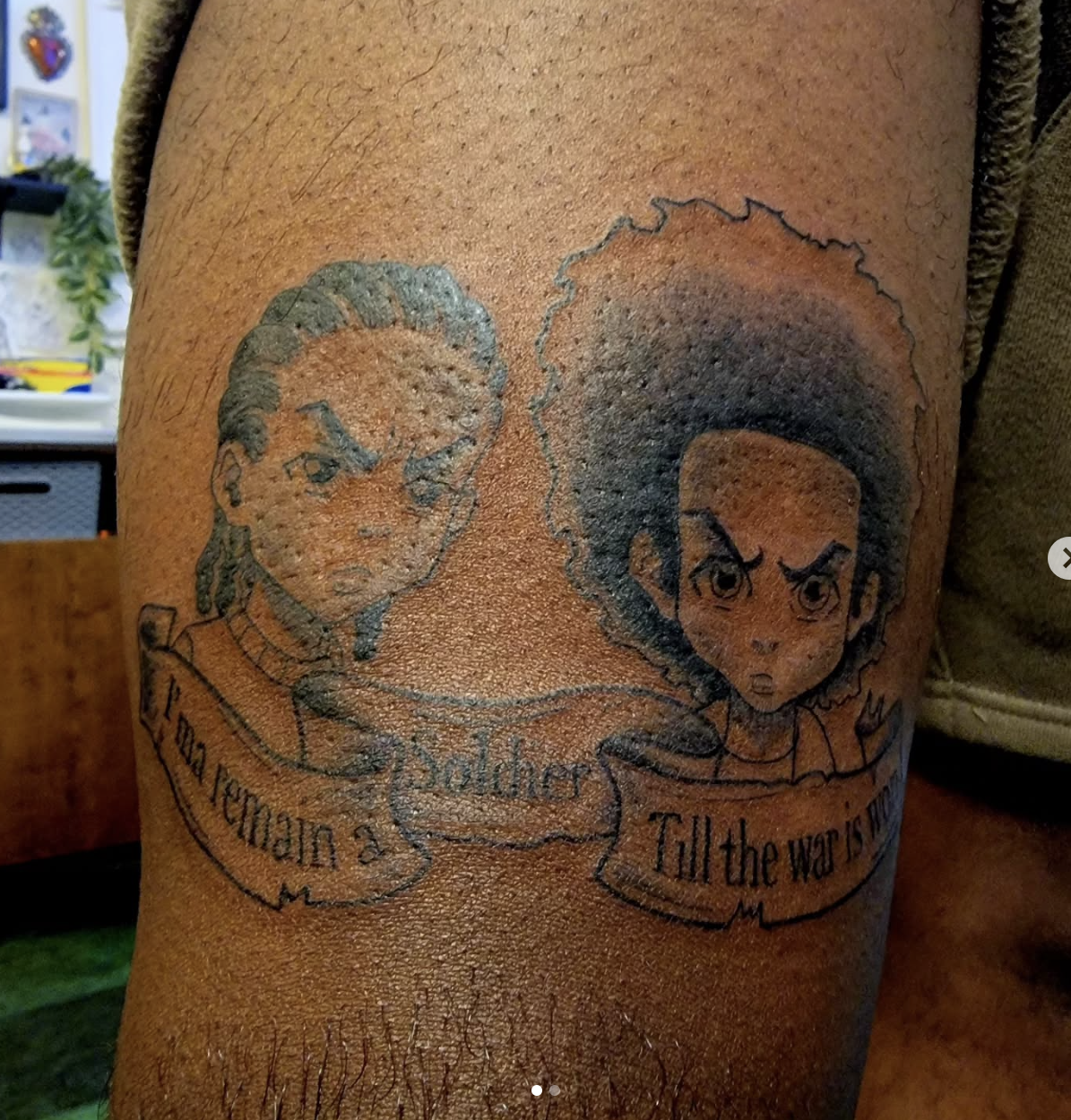
I’ve had Black and brown clients ask me whether a tattoo will actually show up on their skin. I’ve also heard people repeat the idea that certain colors, styles, or details simply “don’t work” on darker skin. So let me get this out of the way first: melanin is not the problem.
Dark skin holds tattoo ink. Dark skin heals tattoo ink. And yes, you can create detailed, beautiful, colorful tattoos on melanated skin. But that does not mean I can take a tattoo designed for somebody else’s complexion, copy it exactly, and expect the same visual result.
I’m not tattooing a white sheet of paper. I’m working with your skin. Your complexion, undertones, placement, anatomy, and the way a design needs to heal all matter. That’s where good tattooing comes in.
A rose can look crisp as hell in a fresh tattoo photo and become a soft gray shape years later if the artist did not build enough contrast into it. That can happen on any complexion. But when I’m designing tattoos for dark skin, I’m especially intentional about value, line weight, negative space, placement, and how I expect that tattoo to heal. I’m not trying to make your tattoo look like it would on lighter skin. I’m trying to make a beautiful tattoo that works with the skin you actually have.
What Makes Tattoos for Dark Skin Read Clearly?
Tattoo ink sits in the dermis, beneath the outer layer of skin. We see that ink through the skin above it, which means your natural skin tone becomes part of how the finished tattoo looks. That is not a flaw. It is simply something I need to consider when I design and tattoo the piece.
This becomes especially important with designs that depend on pale gray shading, tiny openings, or subtle shifts in color. Without enough contrast, details can start blending together as the tattoo settles and ages.
That does not mean every tattoo on dark skin needs giant outlines or heavy black. I hate that assumption because it treats melanated skin like the solution is to just throw more black at it. The real issue is structure.
Take a black and gray raven. I want the silhouette to read. I want the eye and head to have a clear focal point. I want groups of feathers to separate instead of becoming one gray mass. Some areas may need stronger black. Others may need open skin. The goal is visual hierarchy.
And there is no single formula for “dark skin.” Black and brown people come in an enormous range of complexions and undertones. I need to look at the actual person sitting in front of me, not make decisions based on a category.
Contrast Matters More Than Cramming in Tiny Details
I like detail. A lot of my work depends on it. But more detail does not automatically make a better tattoo.
Fine line tattoos can absolutely work on melanated skin. Fine does not have to mean faint. A line can be delicate and still have enough structure to remain visible after healing. Problems start when a design depends entirely on hair-thin lines packed into a tiny space without considering what those lines will look like years from now.
Sometimes my job is to tell you the design needs to be a little bigger. Sometimes I need to simplify an area, strengthen a line, or take something out altogether. I would rather have that conversation before tattooing you than give you exactly what you asked for when I don’t believe it will age well.
Build the Design Around What Matters Most
Every tattoo needs a focal point. In a botanical piece, the important information might be the shapes of the flowers and leaves before we ever get into tiny veins and textures. With an animal, I’m thinking about the eyes, face, silhouette, and major fur or feather patterns first.
Secondary details should support the tattoo, not fight everything else for attention. Even a large sleeve needs strong black areas, open skin, and clear shapes. I want your tattoo to look interesting from across the room, not only when somebody has their phone six inches away from your arm.
Let Negative Space Do Some of the Work
Negative space is one of my favorite tools because sometimes the skin itself needs to be part of the design.
Intentional open areas can separate petals, define a face, preserve a highlight, or keep elements from visually running together. Tiny openings can disappear as a tattoo ages. Larger, deliberate breaks give the design room to breathe. Negative space is not the part I forgot to tattoo. It is part of the composition.
Color Tattoos on Dark Skin: Yes, We Need to Talk About This
Somewhere along the way, people were taught that Black people either cannot get color tattoos or only have a tiny handful of colors available to them. Neither is a useful way to think about it.
Color tattoos can look rich and beautiful on dark skin. What matters is understanding that pigment is viewed through your natural skin tone. I choose color with that relationship in mind instead of expecting pigment to look exactly like it does in the bottle or on somebody with a completely different complexion.
Reds, oranges, yellows, greens, blues, and purples can all have a place in tattoos for dark skin. Undertone matters too. The same orange can read differently on warm medium-brown skin than on a cool deep complexion. That’s why I want to see your actual skin instead of deciding what colors you “can” have from some chart on the internet.
And then there is white ink.
White ink is not a magic highlighter. It rarely stays bright paper-white after healing on anybody. On deeper skin, it may become a softer highlight or barely visible. I can use it strategically, but I do not want an entire design depending on white ink doing something it probably will not keep doing once healed.
Placement Can Change the Result
Where you put the tattoo matters almost as much as what we put there. Placement affects visibility, wear, movement, healing, and how much room I have to build the design properly.
Hands, fingers, feet, and areas around joints deal with a lot of movement and friction. They can soften or fade faster and may need touch-ups. They aren’t forbidden placements. I just want you to understand what you’re signing up for before we put a highly detailed design somewhere that is going to fight us every day.
I’m also looking at how the tattoo moves with you. A snake, botanical branch, animal, or ornamental design should feel like it belongs on that arm, leg, shoulder, or back. Your body is part of the composition. I don’t want the finished tattoo to look like somebody printed an image and stuck it onto you.
Choosing an Artist for Tattoos on Dark Skin
If an artist says they tattoo all skin tones, look at the portfolio.
I mean really look.
If you scroll through two hundred tattoos before finding somebody darker than a paper bag, that tells you something. “I will tattoo Black people” and “I know how to tattoo melanated skin well” are not necessarily the same statement.
And don’t only look at fresh work. Fresh tattoos are on their best behavior. They’re dark, saturated, sharp, and usually photographed under controlled lighting. Healed work tells on everybody.
Look for healed tattoos on complexions similar to yours. Can you still understand the design? Are the lines readable? Is there enough contrast? If color was used, how did it settle?
The consultation matters too. An artist should be able to explain why they recommend a different size, stronger line, revised color palette, or different placement. “That won’t work on dark skin” is not much of an explanation. I want to know why something should change and what we can do instead.
There are times when I will tell a client no. The design may be too small for the detail they want. The placement may work against the piece. That is not me deciding what somebody with brown skin is allowed to have. That is me doing my job and trying to send them home with a tattoo I believe in.
Healing Is When We Find Out What the Tattoo Really Looks Like
The tattoo is not finished just because you got out of my chair.
Fresh tattoos can be dramatic. Everything is darker. Black looks incredibly black. Color is saturated. Then healing starts, and the tattoo settles into what it is actually going to become.
Your tattoo may look dull, cloudy, flaky, or uneven for a while. Don’t start picking at it because one little section looks weird on day four. Let your skin do its job.
Follow your artist’s aftercare instructions. Keep the tattoo clean, moisturize appropriately, avoid pools and hot tubs while it heals, and protect it from prolonged sun exposure. Once it is fully healed, sunscreen can help protect it from premature fading.
If you develop worsening pain, spreading redness, unusual heat, discharge, or something else that genuinely concerns you, talk to a medical professional. I can tell you how I expect a tattoo to heal and how I want you to care for my work. I am still a tattoo artist, not your doctor.
Your Skin Is Not the Problem We Are Trying to Solve
This is probably the part I care about most.
I do not want Black and brown clients walking into tattoo shops already apologizing for their skin. I do not want somebody assuming they cannot have detail, color, softness, or a particular subject because their complexion is deeper than the person in the reference photo.
Sometimes a design needs to change. Sometimes a color choice needs to change. Sometimes I want more contrast, more room, or a different placement. But that is tattooing. I make those decisions because every body in my chair is different.
Your skin is part of the artwork. It is not an obstacle sitting between me and the artwork.
A tattoo that ages beautifully is rarely an accident. It comes from a design made for the person wearing it, an artist willing to be direct about what will hold up, and aftercare that gives the work a real chance to heal well.
Bring me the story. Bring me the references. Bring me the weird idea you’ve been trying to explain to people and the screenshot you’ve had saved in your phone for two years. We can figure out what belongs, what needs to change, and how to turn it into something designed for your body, your skin, and you.