
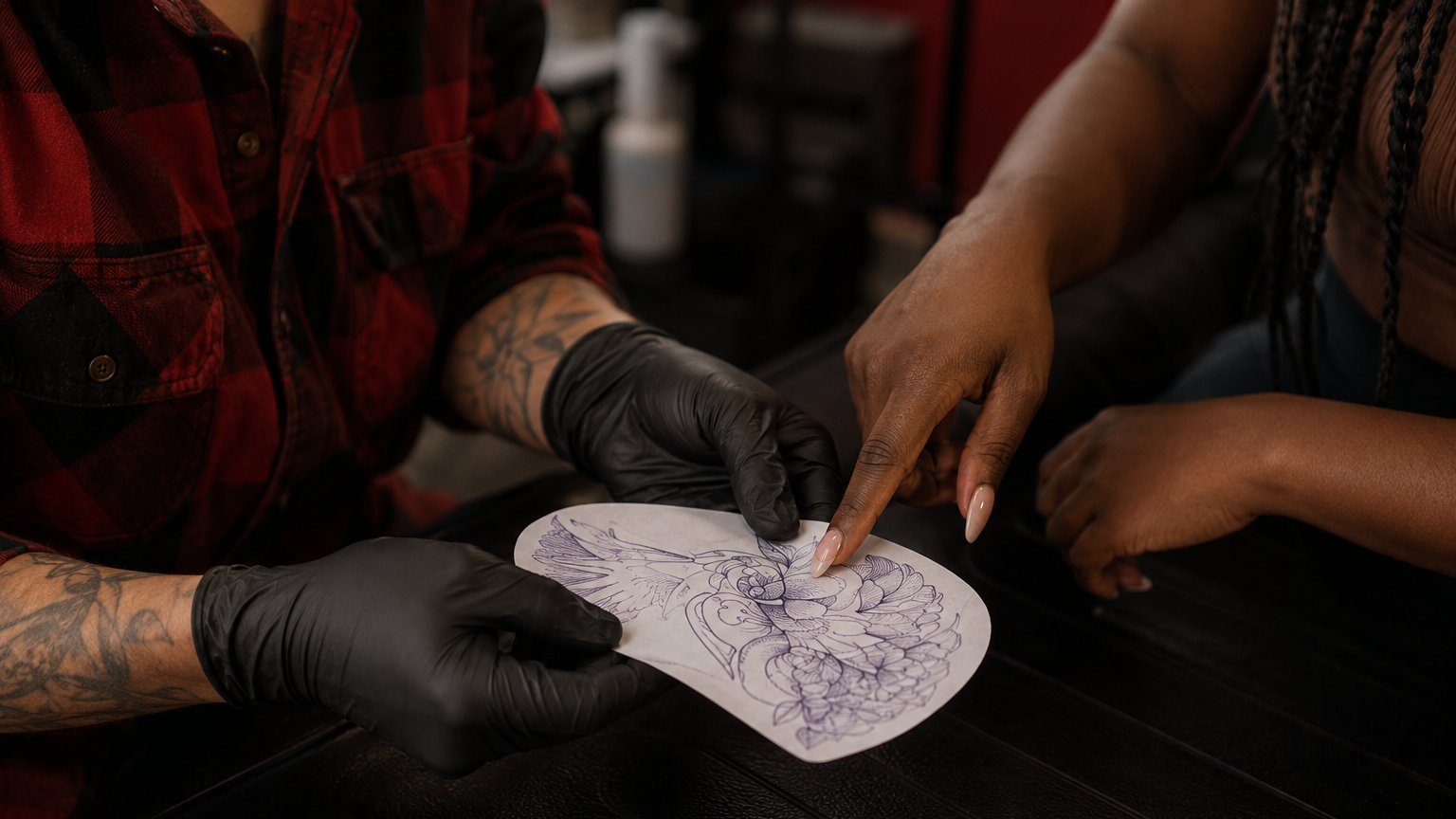
If you’re wondering what actually happens at a tattoo consultation, you’re probably carrying more than one question. You may have an idea you care about but cannot quite picture on your body. You may be wondering how much to share, whether your reference images are enough, or how an artist decides what will actually age well. A good consultation is where those loose pieces become a realistic plan.
Once you come in for your consultation, I’m not trying to rush you into booking. I want to understand the project, talk honestly about what will work, and make sure we’re a good fit before either of us commits to the tattoo.
A Consultation Starts With the Idea, Not a Finished Design
You do not need to arrive with perfect artwork. In fact, most custom tattoo clients should not. A consultation is usually most useful when you bring the core of the idea: the subject, feeling, story, or visual direction behind it.
For a nature-inspired piece, that might mean you know you want a raven, wildflowers, and a darker black and gray mood, but you do not know how those elements should interact. For an anime-inspired tattoo, it may mean you have a character or scene in mind but want it interpreted in a way that feels personal rather than copied directly from a screenshot.
The artist will ask questions that get beneath the first description. Why this image? Is the tattoo meant to feel quiet, bold, sentimental, graphic, or strange? Are there details that matter most? Are there elements you definitely do not want? These answers give the artist creative direction without turning the process into a request for a carbon copy of someone else’s tattoo.
Reference images are welcome, but they work best as a visual vocabulary. A photo can show a pose you like. Another can show line weight, texture, or composition. A third can clarify the mood. The goal is to identify what you respond to, then create original work around that information.
What Happens at a Tattoo Consultation for Placement and Size
Placement is not an afterthought. It changes how a tattoo reads, how much detail it can hold, how it moves with the body, and how comfortable the session may be.
Your artist will look at the area you are considering and discuss the shape of the body part. A long botanical stem may flow naturally along a forearm or calf. An animal head may need a wider, flatter area, such as the upper arm, thigh, chest, or back, to keep its features clear. Fine line work can be beautiful in smaller placements, but extremely tiny detail often loses definition over time.
This is where honest advice matters. The smallest version of an idea is not always the best version. If a design includes delicate faces, tiny leaves, fur texture, lettering, or multiple characters, the artist may recommend increasing the size or simplifying parts of the composition. That is not an attempt to make the tattoo bigger for the sake of it. It is a decision about longevity.
The conversation also covers visibility. Some clients want a tattoo they see every day. Others need a placement that is easier to cover for work, family, or personal reasons. There is no universal right answer, but it helps to be candid about your life before the stencil is on your skin.
Skin Tone, Style, and Long-Term Readability
A skilled consultation should account for skin tone and skin characteristics without making broad assumptions. Tattoos can look striking on melanated skin and across a wide range of complexions, but contrast, line weight, color selection, and healed appearance all need thoughtful consideration.
For black and gray work, the artist may discuss where enough contrast can be created so the design remains readable after healing. For color, they may recommend certain pigments or a stronger value structure rather than relying on very pale, low-contrast shades. Skin undertones, sun exposure, scars, and the exact placement can all affect the approach.
This conversation should be practical, not discouraging. An artist should explain trade-offs clearly: very soft gray shading may heal more subtly on some skin tones; ultra-fine lines may not provide the definition a detailed concept needs; a bolder outline may better protect the design’s clarity. The best plan is one designed for your skin, not a design copied from a photo of someone else’s.
The Artist Will Set Creative and Professional Boundaries
A consultation is also where you learn how the artist works. Custom tattooing is collaborative, but it is not the same as commissioning a logo with unlimited revisions. The artist needs room to solve composition, flow, and technical decisions in a way that serves the tattoo.
You can expect a discussion about the artist’s style and whether it fits your project. A good artist may say no to work outside their strengths, to a design that is too small for its detail, or to an exact replica of another tattooer’s work. Those boundaries protect both the client and the work. I’d rather tell someone no than agree to a tattoo I don’t think I can execute well.
Ask how the design process is handled. Some artists prepare artwork closer to the appointment so it is fresh and tailored to the final placement. Others share a concept in advance. Find out when you will see the design, what minor adjustments can be made, and what happens if the direction needs more substantial revision. Clear expectations prevent a lot of unnecessary anxiety.
Budget, Sessions, and Deposits Should Be Discussed Plainly
A consultation should give you a realistic sense of cost, though a precise final price is not always possible before the design and size are finalized. Larger custom work, detailed black and gray shading, and multi-session pieces require more planning and tattoo time than a small, simple design.
Your artist may provide an estimate, an hourly rate, or a session rate depending on the project. Ask what that estimate includes and whether the tattoo is likely to take one session or several. If you have a firm budget, say so early. It may influence the scale, level of detail, or the decision to build the tattoo in stages.
Deposits are commonly used to reserve appointment time and cover the drawing process. The consultation is a good time to understand the studio’s deposit, rescheduling, cancellation, and late-arrival policies. These are not minor details. Custom tattoo appointments involve dedicated design time and a schedule that cannot always be filled at the last minute.
You Can Talk About Comfort, Pain, and Preparation
First-time clients often worry that asking about pain will make them seem unprepared. It will not. Pain varies widely by placement, duration, sleep, stress level, and individual tolerance. Areas close to bone or with thinner skin can feel more intense, while some people find the experience manageable but tiring rather than sharply painful.
Your artist can help you choose a placement that makes sense for both the design and your comfort level. They can also explain practical preparation: eat a solid meal, hydrate, sleep well, wear clothing that gives access to the area, and don’t come to your appointment under the influence. If you have medical concerns, allergies, a history of fainting, or skin conditions affecting the placement, bring them up before booking.
It is equally useful to ask about healing. You should leave knowing the broad aftercare expectations, how long the area may be tender, and whether your schedule includes activities that could interfere with healing, such as swimming, heavy sun exposure, or a physically demanding event.
Leave With a Plan, Not Pressure
By the end of a strong consultation, you should know the proposed direction, likely placement and size, approximate budget, scheduling steps, and any decisions you need to make before the appointment. You should also feel heard without being promised something that cannot be delivered.
If you are still uncertain, give yourself room to think. The right tattoo usually becomes clearer after an honest conversation about what it needs to be, not after a rushed decision. Bring the idea, bring the questions, and together we’ll figure out what the tattoo actually needs to become.